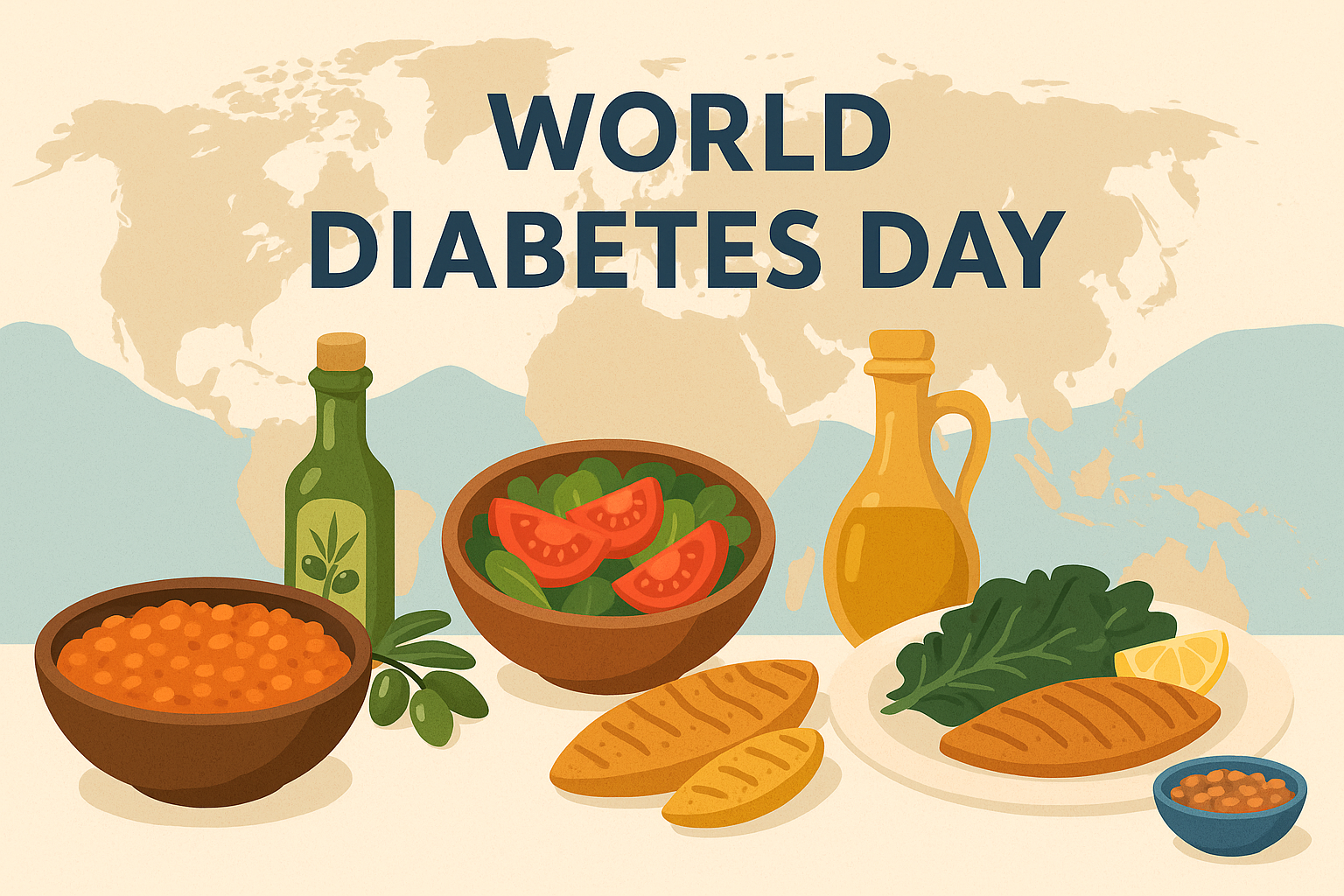
World Diabetes Day: How Different Cultures Find Their Own Way
Diabetes is part of daily life for people all over the world. Cold northern cities, warm coastal towns, busy capitals and quiet villages all have people living with type 2 diabetes.
People eat very different foods and move in very different ways, yet the same condition appears. This reminds us that diabetes is not caused by one single food or one single habit. It is shaped by many things, including genes, sleep, stress, movement and the food that is easiest to find where you live.
World Diabetes Day is a good moment to look at how different cultures live with diabetes and to see what ideas we might safely borrow.
Europe
In Europe there is more than one useful way of eating.
In southern Europe, many people follow a Mediterranean way of eating. Meals often include vegetables, beans and lentils, wholegrains, olive oil, nuts and fish. Large Spanish studies known as PREDIMED found that a Mediterranean pattern with extra olive oil or nuts reduced the chance of getting type 2 diabetes in people at high cardiovascular risk when compared with a lower fat diet and also reduced heart disease events overall (1, 2).
In northern Europe, traditional foods often include oats, rye, barley, root vegetables and berries. These foods are rich in fibre. Big population studies and reviews show that people who eat more wholegrains have a lower risk of developing type 2 diabetes than those who eat very little (3, 4)
Some people in Europe use apple cider vinegar before meals. Clinical trials in people with type 2 diabetes suggest that daily apple cider vinegar, taken in small amounts and well diluted, can improve blood sugar and cholesterol levels, and that vinegar with meals can reduce the rise in blood sugar after eating (7, 8). It is not suitable for everyone and should not replace prescribed treatment.
South Asia
In India, Pakistan, Bangladesh and Sri Lanka, many meals are built around lentils, chickpeas, beans, vegetables and flatbreads or rice. These foods are naturally rich in fibre and protein and can help slow the rise in blood sugar after eating.
Some families cook with bitter melon. Reviews and trials suggest that bitter melon extracts can lower fasting blood sugar and HbA1c in some people with type 2 diabetes, but the evidence is mixed and product quality and dose vary. A major Cochrane review concluded that we do not yet have strong enough evidence to use bitter melon as a treatment on its own (9). It is safer to see it as one vegetable within a wider eating pattern, never as a replacement for medicines.
Daily life in South Asia often includes walking, informal exercise and household work, which all help with blood sugar control.
Africa
Across many African countries, traditional meals are often home cooked and plant rich. Beans, peas, lentils, vegetables, millet and other wholegrains, together with root crops, appear in stews and porridge dishes.
These foods tend to be filling and high in fibre. Using them in place of very refined starches can support more even blood sugar levels over the day.
Walking is still a normal part of life for many people, whether for work, school or errands. This kind of steady everyday movement is one of the best proven ways to help manage type 2 diabetes, alongside food and medicines.
East Asia
In China, Japan and Korea, many traditional meals are based on vegetables, tofu, mushrooms, sea vegetables, rice and fish. Large reviews show that higher intake of fruit and especially green leafy vegetables is linked with a lower risk of type 2 diabetes (5, 6).
Gentle movement such as tai chi, group walking and stretching in parks is part of daily life for many older adults. This calm regular activity supports balance, mood and blood sugar control.
What the research says about food patterns
If we stand back from the details, a clear picture appears. Diets that are rich in vegetables and fruit, beans and lentils, and wholegrains such as oats and brown rice are linked with a lower risk of developing type 2 diabetes in large long term studies (1, 3, 4, 5, 6). Patterns like the Mediterranean way of eating, which bring these foods together with olive oil and nuts, are especially well studied (1, 2). Trials also suggest that small amounts of vinegar with meals, including apple cider vinegar, can modestly improve blood sugar after eating, while herbs such as bitter melon may have some effect but are not strong enough to replace standard treatment (7, 8, 9).
None of these foods can cure diabetes. They work best when they are part of an overall pattern of eating that is rich in plants and whole foods and limits sugary drinks and highly processed food.
Why this matters for World Diabetes Day
World Diabetes Day is not just about numbers. It is also about people and how they live right now.
We now live in a globalised world. Supermarkets and local shops stock ingredients from many different cultures. This means we can take ideas from other places and gently fit them into our own lives.
Someone in India might take inspiration from the Mediterranean diet and choose to cook more often with olive oil, which is now easier to find in many cities. Someone in Europe may decide to make more curries and stews with lentils and chickpeas, which are now widely available and affordable. Someone in Africa might experiment with adding extra green leafy vegetables to traditional dishes. Someone in East Asia might use more wholegrain breads or cereals that are common in Europe.
There is no single right way. But by looking at what different cultures do, and what research says about their foods, we can pick out small changes that feel realistic for us.
You do not need to copy another culture completely. A simple step, such as adding an extra serving of vegetables, swapping some white bread for wholegrain, making a bean based meal once a week, or finding ten minutes a day for a gentle walk, can be a good place to start. If you want to try anything new, especially things like vinegar drinks or bitter melon, it is always safest to speak to your diabetes nurse, pharmacist or doctor first in case there are some specific reasons that you may need to take more care.
References
- Salas Salvado J, Bullo M, Estruch R et al. Reduction in the incidence of type 2 diabetes with the Mediterranean diet. Diabetes Care. 2011 34 14 to 19. PubMed
- Estruch R, Ros E, Salas Salvado J et al. Primary prevention of cardiovascular disease with a Mediterranean diet supplemented with extra virgin olive oil or nuts. New England Journal of Medicine. 2018 378 e34. predimed.es+1
- Aune D, Norat T, Romundstad P, Vatten L. Whole grain and refined grain consumption and the risk of type 2 diabetes. European Journal of Epidemiology. 2013 28 845 to 858. ScienceDirect+3PubMed+3SpringerLink+3
- Fung TT, Hu FB, Pereira MA et al. Whole grain intake and the risk of type 2 diabetes in men. American Journal of Clinical Nutrition. 2002 76 535 to 540. PubMed
- Li M, Fan Y, Zhang X et al. Fruit and vegetable intake and risk of type 2 diabetes mellitus. BMJ Open. 2014 4 e005497. BMJ Open+1
- Carter P, Gray LJ, Troughton J et al. Fruit and vegetable intake and incidence of type 2 diabetes mellitus. BMJ. 2010 341 c4229. BMJ+1
- Jafarirad S, Elahi N, Mansoori A et al. The improvement effect of apple cider vinegar as a functional food on anthropometric indices, blood glucose and lipid profile in diabetic patients. Frontiers in Clinical Diabetes and Healthcare. 2023 4 1288786. PubMed+2Frontiers+2
- Gorska M, Pietrzak D, Szulinska M. Apple cider vinegar in the combat against type 2 diabetes. Quality in Sport. 2024. Akademicka Platforma Czasopism+1
- Ooi CP, Yassin Z, Hamid TA. Momordica charantia for type 2 diabetes mellitus. Cochrane Database of Systematic Reviews. 2012 CD007845. ScienceDirect+4Cochrane+4PubMed+4