


One Pair Cannot Do Everything: Choosing Footwear for What You Actually Do
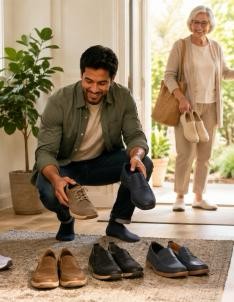
Most of us own more than one pair of shoes for a reason.
The shoes you wear to work may be different from the ones you wear for a long walk. You may have something easy to put on around the house, another pair for exercise, and something completely different for a special occasion.
That is perfectly normal.
The mistake is thinking that one type of shoe should be right for every activity.
There is no single perfect shoe. What matters is choosing footwear that suits your feet, what you are doing, and how long you plan to be doing it.
Start with the activity
Before you think about brands, styles or what is fashionable, ask a simple question.
What am I going to do in these shoes?
- If you are walking a short distance, you may not need the same level of grip, cushioning or foot control as you would for a long walk.
- If you are gardening, you may want something easy to clean and protective.
- If you are exercising, your shoes may need to cope with faster movement, changing direction or repeated impact.
- If you are going to be on your feet for several hours, comfort becomes even more important.
A shoe only works well when it matches the job you are asking it to do.
Your everyday shoes matter most
It is easy to spend a lot of time choosing shoes for walking or exercise and forget about the footwear you use every day.
Think about what you wear:
- At home.
- At work.
- When shopping.
- When visiting friends and family.
- When walking.
- When exercising.
The shoes you wear most often may have the biggest effect on how your feet feel.
If you regularly develop pain, rubbing or tired feet, think about what you were wearing when the problem happened. That can often tell you more than looking at one pair of shoes in isolation.
Different shoes change how you move
Footwear changes the way your foot meets the ground.
The shape of the sole, its thickness, its stiffness, the height of the heel and the way the shoe holds your foot can all affect movement.
This does not mean that one design is always better than another.
It means different shoes can place different demands on your feet and legs.
A lightweight flexible shoe may feel very different from a thick cushioned trainer. A very flat shoe may feel different from something with a raised heel. A loose shoe may require more effort to keep it on your foot than one that is securely fastened.
The important question is whether that change suits you.
Give yourself time to adapt
Sometimes people make a big change in footwear because they have seen a new style, heard a recommendation, or simply fancy trying something different.
That can be fine.
But your feet and legs may need time to get used to it.
Research into different types of running footwear has shown that the way shoes affect the body can depend partly on what someone is already used to wearing.
The same practical idea can be useful in everyday life.
If you move from your usual shoes to something very different, start gradually.
Wear them for a short period first.
See how your feet and legs feel.
Build up slowly if everything feels comfortable.
If you develop new pain, rubbing or discomfort, do not simply assume that you need to push through it.
More technology does not always mean a better shoe
Modern shoes can include thick cushioning, shaped soles, special materials and many other design features.
Some of these can be very useful.
But more features do not automatically make a shoe better.
A simple shoe that fits your foot, feels comfortable and suits the activity may be a better choice than a highly technical shoe that does not work for you.
The same applies to price.
The most expensive shoe is not automatically the healthiest shoe.
What matters is how well it works for your foot and what you need it to do.
Think about comfort and confidence
Your shoes should help you move with confidence.
If you feel that a shoe is slipping, rubbing or making you unstable, pay attention to that feeling.
Comfort also matters.
People are much more likely to wear footwear they actually like and feel comfortable in. That may sound obvious, but it is important. A shoe cannot help you if it spends most of its time in the cupboard.
Good footwear advice should therefore take account of your daily life, not just your feet.
Do not forget personal choice
Shoes are not simply pieces of medical equipment.
We choose them because of how they look, how easy they are to wear, where we are going and how they make us feel.
That matters.
The aim is not to remove personal choice. It is to balance appearance, comfort and function.
You should be able to find footwear that suits your life as well as your feet.
A simple way to choose
Before putting on a pair of shoes, ask yourself:
- Does this suit what I am doing today?
- Will I be comfortable wearing it for as long as I need to?
- Do I feel stable when I stand and walk?
- Is anything rubbing or pressing?
- Is this very different from what I normally wear?
- If the shoe feels right for the activity and right for you, that is a good starting point.
At MyHealthKits, we focus on practical ways to help you take more control of your health at home. Footwear is one part of that. Small choices made every day can help you stay comfortable, active and confident.
References
- Branthwaite H, Chockalingam N. Everyday footwear: an overview of what we know and what we should know on ill fitting footwear and associated pain and pathology. The Foot. 2019;39:11 to 14.
- Branthwaite H, Chockalingam N, Grogan S, Jones M. Footwear choices made by young women and their potential impact on foot health. Journal of Health Psychology. 2013;18:1422 to 1431.
- Hurst B, Branthwaite H, Greenhalgh A, Chockalingam N. Medical grade footwear: the impact of fit and comfort. Journal of Foot and Ankle Research. 2017;10:2.
- Branthwaite H, Chockalingam N, Greenhalgh A, Chatzistergos P. The impact of different footwear characteristics of a ballet flat pump on centre of pressure progression and perceived comfort. The Foot. 2014;24:116 to 122.
- Cowley EE, Chevalier TL, Chockalingam N. The effect of heel height on gait and posture: a review of the literature. Journal of the American Podiatric Medical Association. 2009;99:512 to 518.
- Sinclair J, Huang G, Taylor PJ, Chockalingam N, Fan Y. Effects of running in minimal and conventional footwear on medial tibiofemoral cartilage failure probability in habitual and non habitual users. Journal of Clinical Medicine. 2022;11:7335.