


Is exercise enough for weight loss?
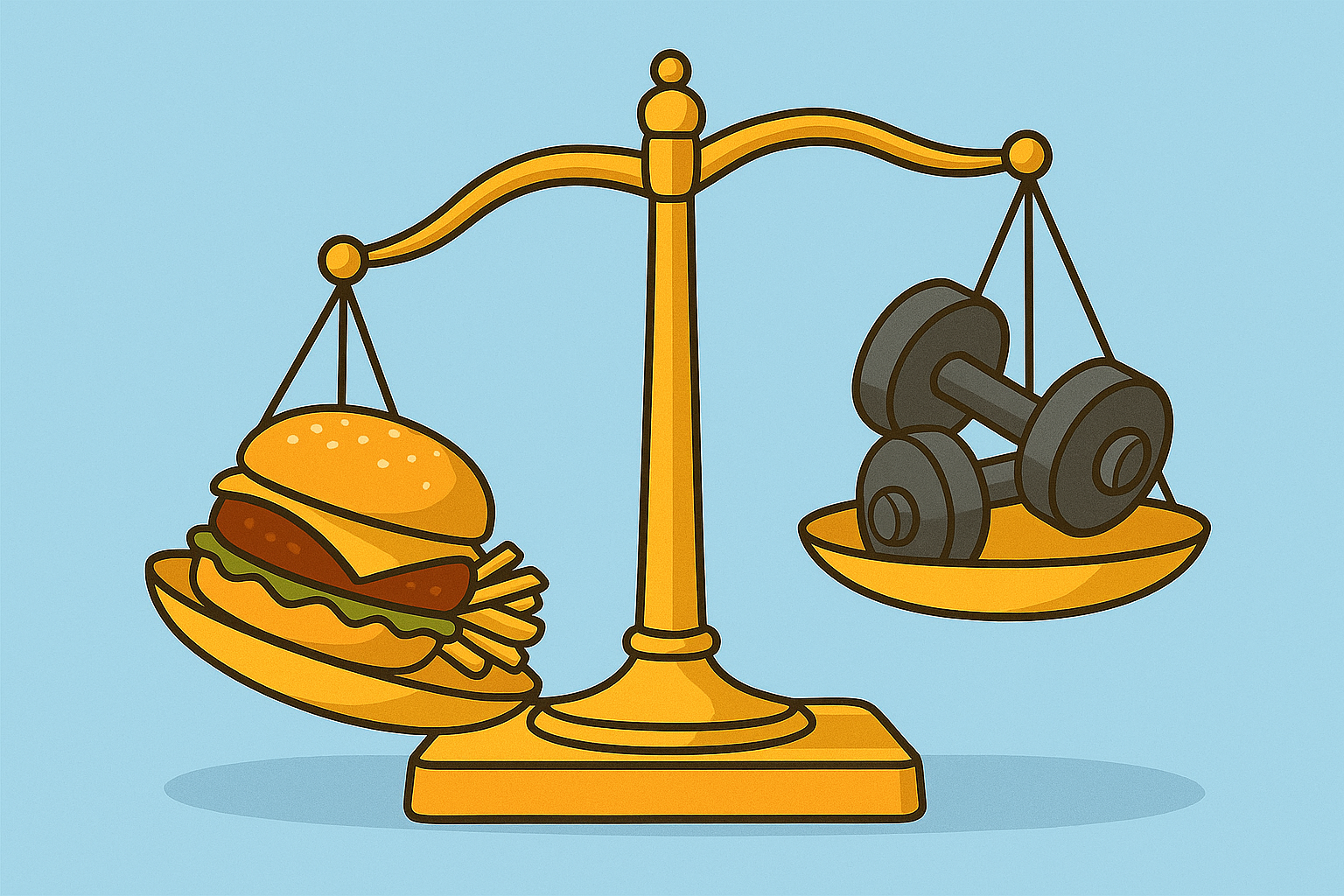
So many of us struggle with reaching and maintaining our ideal body weight. We’re told the answer is simple: eat less and move more. But if it’s really that simple, why do so many of us find it so difficult?
There’s a growing body of evidence that suggests we might have been looking at the problem the wrong way. In particular, our assumptions about the role of exercise in weight loss appear to be fundamentally flawed.
When most of us decide to lose weight, one of the first things we do is sign up for a gym membership or buy a new pair of running shoes. It’s a familiar ritual. And yet, it rarely seems to lead to real success. In fact, large studies now show that people who exercise in order to lose weight often don’t lose any weight at all. Some even gain weight! (1)

Figure 1: The traditional model of metabolism dictates that the more exercise you do, the more calories you burn with your BMR remaining constant.
This is because it appears we’ve misunderstood how our metabolism works. In school biology, you might remember being taught that the total number of calories we burn each day is made up of our basal metabolic rate (BMR) — the energy our body uses just to stay alive — plus any exercise we do on top of that. It sounds intuitive enough: if you move more, you burn more, and if you burn more, you should lose weight.
But this model assumes that our BMR is fixed. It assumes that no matter how much exercise we do, the amount of energy our body uses to run itself stays constant. It turns out, that assumption is wrong.
Your BMR is not a rigid, unchanging number. It can actually vary greatly depending on what your body perceives as necessary for survival. This idea has been explored extensively by anthropologist Herman Pontzer, whose work measuring energy expenditure across a wide variety of populations has shown something surprising: regardless of whether someone is mostly sedentary, training for a half-marathon, or living an intensely active life as a hunter-gatherer, most people burn about the same total amount of energy each day.
That’s not to say that your treadmill or smart watch is lying to you. The calories it says you’ve burned from your run aren’t wildly wrong. The problem is what it doesn’t tell you: that your body will compensate for that activity by burning less elsewhere, particularly from your basal metabolic rate. To put numbers on it, someone who exercises intensely every day might burn only around 200 kilocalories more per day than someone who spends their day on the sofa. That’s about the energy in a single chocolate bar. Not nothing — but far less than we might expect.

Figure 2: In the Constrained Energy Model of Metabolism, people who exercise only burn 200kcal more than individuals who are sedentary as their BMR is suppressed in response.
This is because the body adapts. When you exercise more, it doesn't simply add that energy use on top; it compensates by dialling down other internal processes. One striking example is seen in women who train intensely and lose their menstrual cycle. The body recognises that reproduction is not essential when energy is scarce and temporarily shuts it down.
From an evolutionary perspective, this makes sense. If you’re spending all day running, whether fleeing a predator or searching for food, it's not the right time to reproduce. The body shifts its focus from growth and reproduction to basic survival. Rather than burn through all its reserves, it conserves energy by scaling back less essential systems.
This survival-first approach doesn’t just affect reproductive function. The body also reduces energy spent on high-demand systems like the immune and stress responses. As a result, some people experience improvements in inflammatory conditions such as autoimmune disease, and also notice a reduction in anxiety and stress.
In essence, the body enters a more energy-efficient state designed to help it endure until times are more plentiful. This may partly explain why individuals who exercise regularly often appear biologically younger — their bodies are continually adapting in ways that favour resilience and preservation.
It’s important to clarify that not everyone burns the same number of calories each day. Body size, age, sex, muscle mass and other factors all play a role. However, what Pontzer’s research (2) shows is that the amount of exercise we do is not the key determinant of our total daily energy expenditure. Our bodies are clever enough to adjust and maintain a relatively fixed budget of energy each day, regardless of how we choose to spend it.
And yet, this is not common knowledge. This seems to be a combination of mainstream outdated science and suiting the status quo for us to believe otherwise. If we continue to believe exercise is the main factor behind weight loss, we continue to stay stuck in the familiar yet often unsuccessful rituals
So what does this all mean for weight loss?
It means, unfortunately, that it’s very difficult to “outrun” a poor diet. In fact, the only consistent way to lose weight is by focusing on what you eat. That doesn’t mean exercise isn’t incredibly important. Quite the opposite — regular physical activity benefits nearly every system in the body. If you're currently struggling with your weight, you’re also at increased risk of conditions like diabetes and cardiovascular disease, and it’s precisely these areas where exercise can offer profound protection and improvement.
But weight loss is not one of those benefits.
In my next post, I’ll explore how exercise plays a very different — and crucial — role when it comes to maintaining weight, rather than losing it. But if you can't wait until then and you're keen to understand more, I highly recommend reading Herman Pontzer’s book Burn.
Key References:
Dugas, Lara R; Harders, Regina; Merrill, Sarah; Ebersole, Kara; Shoham, David A; Rush, Elaine C; Assah, Felix K; Forrester, Terrence; Durazo-Arvizu, Ramon A; Luke, Amy (2011-02-01). "Energy expenditure in adults living in developing compared with industrialized countries: a meta-analysis of doubly labeled water studies". The American Journal of Clinical Nutrition. 93 (2): 427–441. doi:10.3945/ajcn.110.007278. ISSN 0002-9165. PMC 3021434. PMID 21159791
Pontzer, Herman; Raichlen, David A.; Wood, Brian M.; Mabulla, Audax Z. P.; Racette, Susan B.; Marlowe, Frank W. (2012-07-25). "Hunter-Gatherer Energetics and Human Obesity". PLOS ONE. 7 (7): e40503. Bibcode:2012PLoSO...740503P. doi:10.1371/journal.pone.0040503